
Transcribing THE EARL HINES ORCHESTRA
Bringing back the music of the Swing Era to Lindy Focus and the world!
What is the Heritage Sounds Transcription Project?
Since 2016, Lindy Focus has taken on a project to bring back to light the music of one of the legendary bandleaders of the classic Swing era. Previous bandleaders include Chick Webb, Lionel Hampton, Jimmie Lunceford, Erskine Hawkins, and Al Cooper. Lindy Focus ‘26 will focus on reviving the music of Earl Hines.
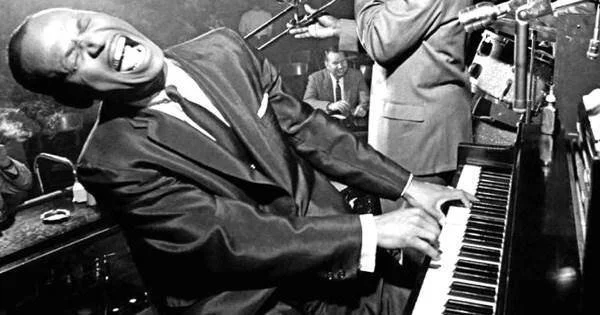
Earl Hines, 1958
Why Earl Hines? A word from Jonathan Stout:
Earl Hines was actually one of the original “Big Three” we envisioned back when the Heritage Sounds/Lindy Focus transcription project was first brainstormed, along with Chick Webb and Jimmie Lunceford. As things progressed, the lure of the Vibraphone (i.e. Lionel Hampton), and connections to the Savoy Ballroom (i.e. Erskine Hawkins and Al Cooper) were impossible to ignore, but Earl Hines was always a part of the plan… or at least it was always part of mine, and now is finally the time.
As a pianist, Earl Hines is one of those singular instrumentalists, like Louis Armstrong, Coleman Hawkins, and Sidney Bechet, who emerged almost fully formed to shape the sound of jazz starting in the early 1920’s, and whose influence remained long after. Known most for his shouting, “trumpet style” octave melody lines, he swung as hard and heavy as even Armstrong. But he was also known for “time defying” breaks that had no equal.
But as a bandleader, Earl Hines was also on the vanguard from the 1920’s through the 1940’s. In the early 1930’s , he had his own distinctive version of “early big band” sound compared to contemporaries Fletcher Henderson and Duke Ellington. The addition of saxophonist and arranger Jimmy Mundy in 1933 set the template for “Swing” years before Mundy began arranging for other bands like Benny Goodman. And all of this influence from his house gig at the Grand Terrace in Chicago, and the strong radio broadcasts that carried his sound across the midwest. And even into the 40’s, Hines reinvented his sound, taking influence from many of the young musicians who were creating Bebop. But importantly he did this without merely turning into Bebop, so the band kept jumpin’.
Hines has been on my list for over a decade, but it wasn’t until I put together the set list, that I realized what a fantastic night of dance music we have in store for you all. We’ve got some favorites, and some surprises planned, and I can’t wait to share the music of Earl Hines and his Orchestra with you.
Why do we do this?
We do this every year because we think this music is wonderful, joyous, and important to preserve. Our hope is to be able to bring affordable, quality big band swing charts to bands, schools, and swing dancers around the world.
Because it’s awesome!
Why not?
One thing that has always been true of Lindy Focus, is that the folks behind the music have never chosen to do things the easy way, and that's a big part of the reason why Lindy Focus has a reputation for excellent music. Its through the tireless (and underpaid) work of folks like Michael Gamble, Jonathan Stout, Laura Windley and many more that we are able to continue to make more of the music we love with the people we love. Without a ready and waiting audience and the support of Jazz lovers like you, this music could be lost to sands of time.
How To Sponsor a Song:
This year we’ve made it easy to support Earl Hines Orchestra Transcription Project by including it on our registration form! Scroll about halfway down the form, and you’ll see a new section just below “The Lindy Focus Learning Fund” and above “Merch & Extras.” Purchasing a pass to the event is not required to sponsor.
There are two ways to donate:
Contribute towards transcription: Contribute an amount of your choosing that goes towards the transcription project as a whole, rather than a specific song.
Fund a full song: $300 fully funds the Earl Hines Orchestra song of your choice, while choices last. Song sponsors will be shown on the Lindy Focus '26 live stream during Earl Hines night.
This Year’s Song List:
Blue Skies - Sponsored
Blues in Thirds (1940) - Sponsored
Father Steps In - Sponsored
GT Stomp - Sponsored
Harlem Lament - Sponsored
Mellow Bit of Rhythm - Sponsored
Ridin' and Jivin' - Sponsored
Rock and Rye - Sponsored
Up Jumped the Devil - Sponsored